
Speech Report: Government Funding and Social Enterprise
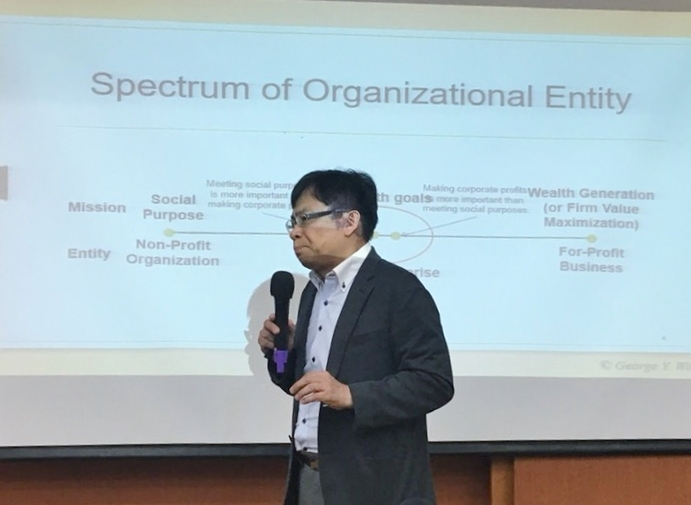
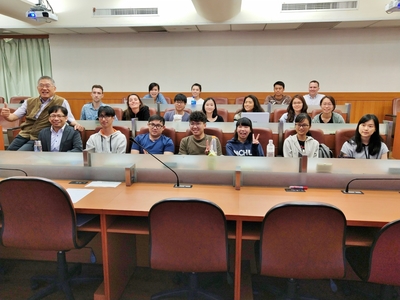
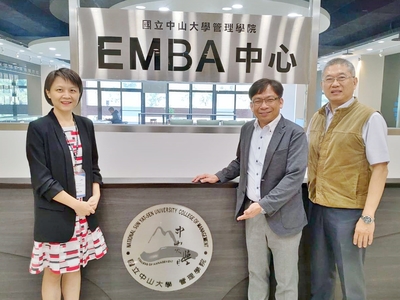
With the rising popularity and focus of social enterprise, many companies have started to focus on investing these industries. Professor Yih Jeng from the College of Management invites his good friend, Professor George Wang, to share some knowledge on how to utilize government funding to help with social enterprise on March 12, 2019. Professor Wang has taught in China before settling in Japan and is currently teaching at Soka University. Although the topic is currently still in works, and Professor Wang would like to share these concepts with the students of NSYSU.
Social enterprise aims to resolve social issue while maintaining financial autonomy and now has become the common ground between for-profit businesses and non-profit organizations. For-profit businesses are traditionally too economically driven to care about the overall environment. On the other hand, NPOs usually run into financial problems, as their default is not to make any economic gains. Social enterprise is composed of five types: community-type, healthcare, entrepreneurial, environmental, and cultural. For example, Nike manufacture their shoes out of recycled materials (environmental) and Uniqlo pushes their own “Japanese underwear” in their clothing line (cultural).
Many social enterprises are from small-medium enterprises (SMEs), despite the social conception that only large companies can fund social enterprises. What are some benefits of SMEs? SMEs can generate high employment rate to combat unemployment and can be profitable. Just like all forms of businesses, there are also inevitable difficulties. Professor Wang mentions that there is generally a lack of corporate resources, as many companies believe that social enterprises do not generate desired revenue and social returns are not apparent in the short run. There is not enough emphasis places on social enterprise and even less available human resource management.
To help promote social enterprise, Professor Wang breaks down the value of a firm and government tools to help reduce costs, such as grant policy and public procurement policy. He further talks about his suggestions to the government. While not all social enterprises need government sponsorship, there are many that do. Based on the Monte Carlo simulation, the government should stop sponsoring the company if the returns of the company exceeds the upper bound and continues to sponsor if the return is below the lower bound. This limitation ensures those who really need the government sponsorship receive appropriate compensations. The probability of success is a critical approach, as success rate is determined by the number of successful companies (those with positive returns) over the total number of companies tested in a given trial. The new approach thus combines the effect of grants and public procurement with the limitations of upper and lower bounds. The suggestions show that while the frequency of the firm’s value still increases over the year, the risk of the corporate is reduced and the effect of the budget can be maximized, ensuring that social enterprises can survive in a competitive pro-profit market. The bounds are determined as ratios based on the sensitivity analysis. The analysis can determine what range generates higher positive returns.
Just like all other case studies, it’s important to extent the research to discussions and potential external influencers. Financial transparency, agency cost, earnings management, and mean-reverting revenues can change the amount of sponsorship. During Q&A, the question of the ratio of the bounds and the actual versus relative sponsorship is brought up. Professor Jeng pitches in his experience as a member of the grant jury. He suggests that the overall time frame is important to consider and that a lot of grant money are not fully utilized, as there is often leftover grant money. Professor Wang concludes that having sustaining financial returns is the ultimate goal. Instead of just giving money, the government wants these companies to eventually gain autonomy to generate their own returns while maintaining financial securities.