【IBMBA】Dr. Hanreich :The Ethics of Business Ethics (BE)
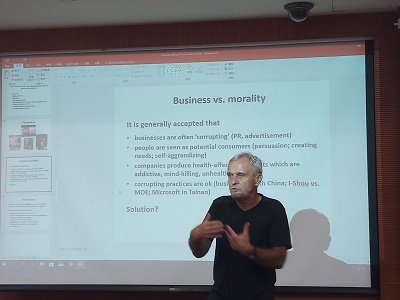
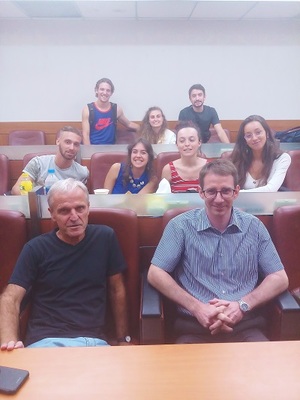
On Tuesday, May 28th, Professor Herbert Hanreich (PhD, 1983, University of Vienna, Austria), visited the College of Management as a guest speaker to deliver at talk on “The Ethics of Business Ethics” in the IB506 Organization Theory & Management class. Professor Hanreich has vast academic and professional experience, with posts at the University of Tuebingen (Germany), the University of Vienna (Austria), the United Nations Association (Vienna, Austria), University of Heidelberg (Germany), Charles University and the Czech Academy of Sciences (Prague, Czech Republic), and professional and academic experience in Taiwan, including at Tamkang University and I-Shou University.
Professor Hanreich opened the talk with a statement from the 2009 Harvard MBA class, a voluntary oath that Harvard students swore in response to the global financial crisis (caused by a large extent by unethical business practices):
“I will lead with integrity. I will manage in good faith. I will uphold the letter and spirit of the law. I will oppose corruption. I will act with justice to all. I will be honest about the risks we face. I will invest in myself and in my profession. I will take responsibility for my actions. I take this oath freely, and upon my honor.
He then asked students if such an oath convinced them and if it was a good way to make the (business) world a better place?
Business ethics is either a triviality or it does not exist. If the term ‘ethical’ means a certain business culture of a corporation or an enterprise, then it usually refers to certain rules of doing fair business to which that company voluntarily intends to comply with. Among those ethical rules we often find the intention: not to cheat; not to overprice products; no price-fixing; to produce products with a certain quality; no bribery-taking and bribery-offering policies; to provide its employees good, safe and healthy working conditions; to grant benefits; to remunerate employees sufficiently; to implement social and environmental policies; to treat employees equally and fairly; to increase participatory rights; to increase transparency of business operations; etc.
Generally speaking, ethically motivated businesses pursue
1. Social responsibility,
2. Environmental sustainability,
3. Fair treatment of its employees, and
4. Solidary policies regarding the common good of a given society.
After covering the different philosophical perspectives of ethics (deontic, virtue, utilitarian, hedonistic, consequentialist) he introduced three major concepts of modern ethical theory: 1. focusing on goals/consequences/utility (result – better world); 2. focusing on individual characters (virtue – acknowledgement), and 3. focusing on motivating thoughts (duty – controlling one’s will). He then discussed ‘freedom’ as a modern ethical concept, which encapsulates personal, political, and global (applied) ethics. Using several real life examples Professor Hanreich elaborated how business leaders are liable to shareholders and supervisory boards, customers and employees, stakeholders and the environment, as well as themselves and a company’s moral code. But which priority should a manager set when one or more of these liabilities become incompatible? How important are business ethics really when it comes to upholding ethical values vs. maximizing profits, moral action vs. losing your job, responsibility towards yourself vs. your company, and individual moral principles vs. common practices? Which ethical paradigm prevails? There are two dominating motivational strategies guiding ethical behavior in business. 1. Pursuing corporate ethical behavior is simply more profitable for the company (‘morality as a business category’), and 2. Successful business promotes the individual, social and political good in general (‘invisible hand’; ‘utilitarianism’; ‘derivative’ welfare). In both cases morality is used as a means for ends which are outside the moral domain – moral standards are transformed into business standards which now sit on the top of moral issues. Often, there is a gap between corporate and individual morality! Double ethic = double standard = hypocrisy?
‘Ethics’, however, in a strict sense refers to a person’s individual moral codes, no matter in which professional or social function that person acts. Going deeper into those codes require a different language game than the ones commonly referring to business ethics. According to Professor Hanreich, ethics really is in distance to business. Its role is to critically observe it from the outside as a corrective is – ought. For businesses to be ethical requires good laws and their strict enforcement, a code of conduct and relevant implementation mechanisms, transparent complaint mechanisms, socially fine-tuned decision makers, participation of employees in internal matters, and civilized business leaders who read literature.
The talked smoothly flowed into a class discussion about ethics, business, and culture. For some students it was the first time to critically engage with the topic and to consider how individual ethics vs. business ethics, a diverse workforce, and globalization, amongst other factors, might affect their very own future career as managers.