
[English Corner] From Cultural Maps to Clear Boundaries: Practical Workplace Insights from IBMBA Alumna Svetlana Boldina
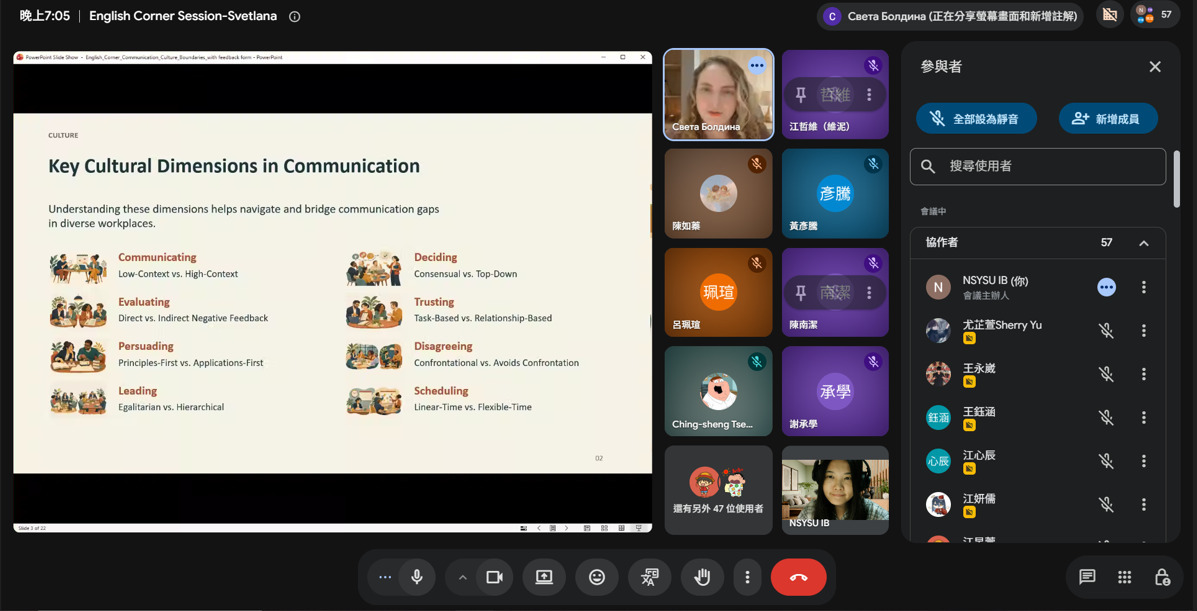
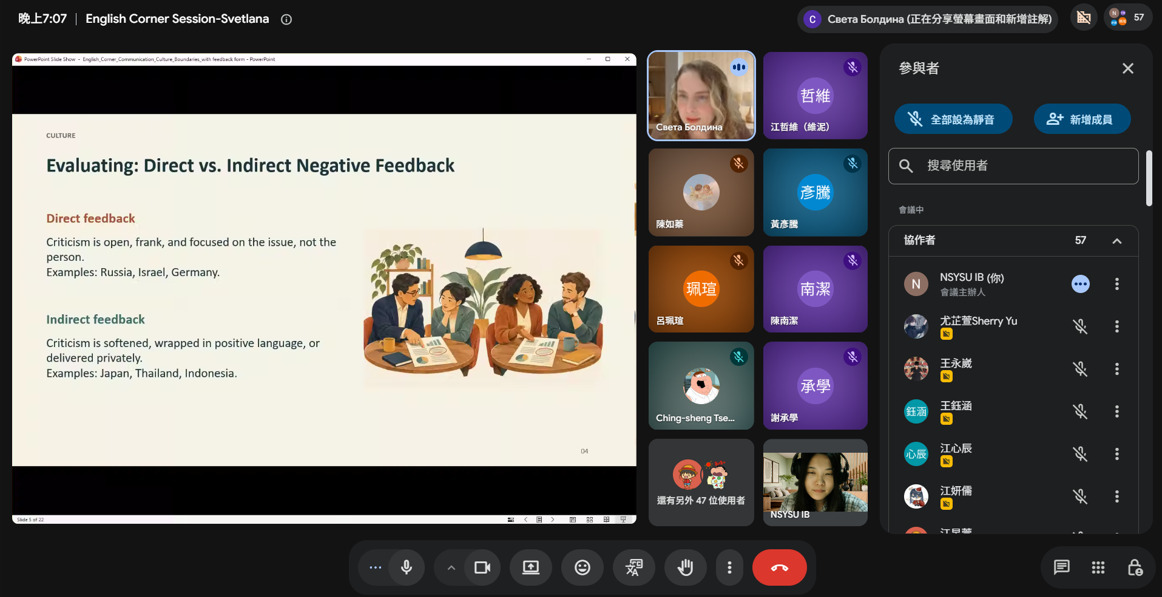
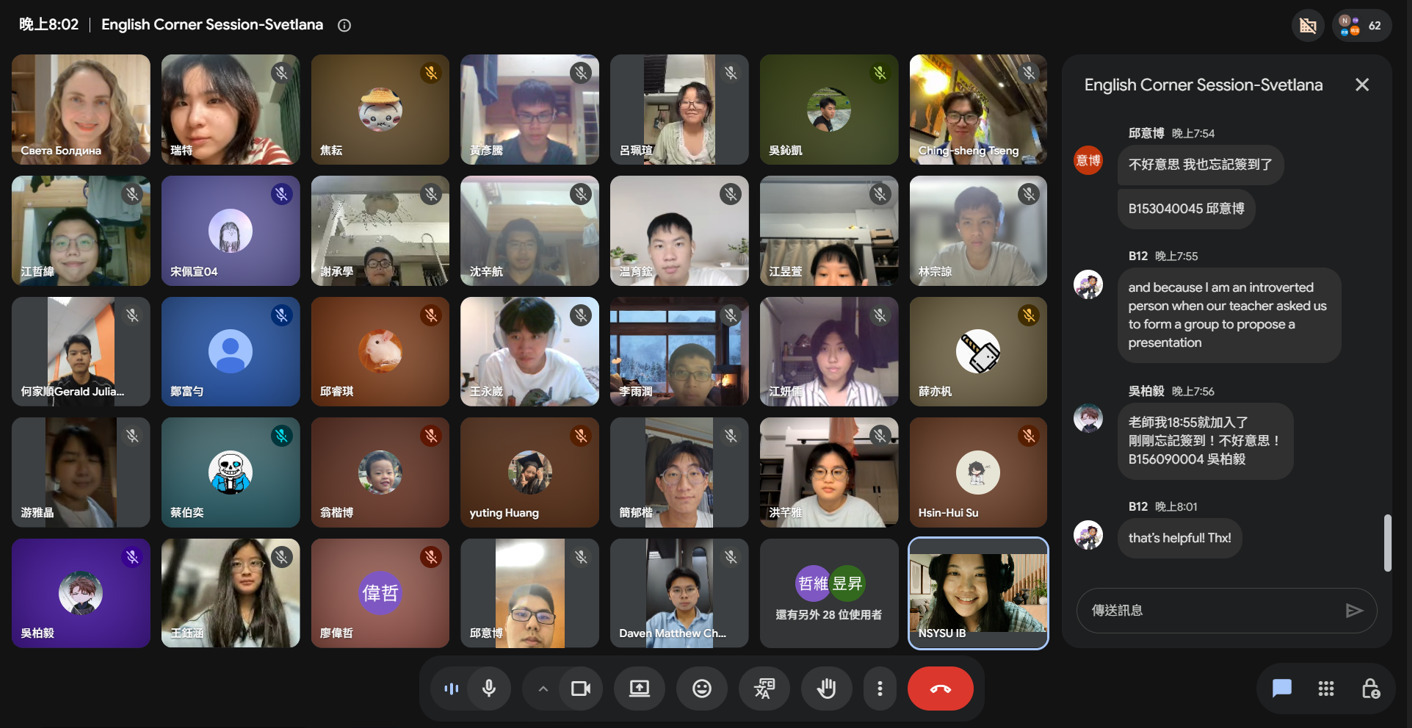
The International Relations and Accreditation Office, College of Management, hosted an online English Corner session on November 10, 2026, titled "The Art of Getting Along at Work: Communication, Culture, and Boundaries," featuring Russian alumna Svetlana Boldina.
From Saint Petersburg to NSYSU: A Cross-Cultural Career Journey, Svetlana Boldina holds a degree in Chinese Culture from Saint Petersburg State University and an IBMBA from NSYSU. She has built her career in Taiwan, with experience in yacht after-sales service and international seafood trade. She now works in the seafood sustainability certification field. Her frontline experience in international account management gave students grounded insights into working across cultures.
Cultural Awareness: Understanding the 8 Cultural Dimensions
Drawing on Erin Meyer's The Culture Map, Svetlana introduced eight cultural dimensions: Communicating, Evaluating, Persuading, Leading, Deciding, Trusting, Disagreeing, and Scheduling. She used an illustrative comparison of Russian and Taiwanese workplace styles to discuss how expectations around feedback and disagreement can differ. While both cultures lean toward high-context communication, Russia tends to favor more direct feedback and open disagreement, whereas Taiwan generally prefers indirect feedback and avoiding confrontation. The comparison highlighted how different cultural expectations can influence workplace interactions and lead to misunderstandings.
Building Relationships and Setting Clear Boundaries
To strengthen cross-cultural teamwork, Svetlana highlighted six relationship-building principles from Dale Carnegie's How to Win Friends and Influence People, including showing genuine interest, active listening, and making colleagues feel valued.
She also emphasized setting healthy boundaries around time, workload, and privacy. Walking through a scenario, she explained how employees can clarify deadlines, discuss priorities, and communicate realistic expectations when facing additional tasks. She added that expressing your limits can help managers spot when work is unevenly distributed across the team.
Making Contributions Visible: Task–Challenge–Action–Result
As a practical career tool, Svetlana introduced the Task–Challenge–Action–Result framework to help students communicate achievements clearly. Contrasting a vague statement ("I helped organize the event") with a specific, outcome-focused update, she showed how highlighting obstacles overcome builds credibility with managers.
Conclusion: Building Confidence Through Practice
During the closing Q&A session, Svetlana encouraged students to step outside their comfort zones and practice communicating with others, even if their first few attempts feel awkward, reminding them that "practice makes perfect."
The College of Management sincerely thanks Svetlana Boldina for sharing practical frameworks and real-world strategies that prepare our students for global careers.