
[English Corner] English Corner: From Details to Stories — Ronnie Nunez Helps Students Strengthen English Speaking and Expression Skills
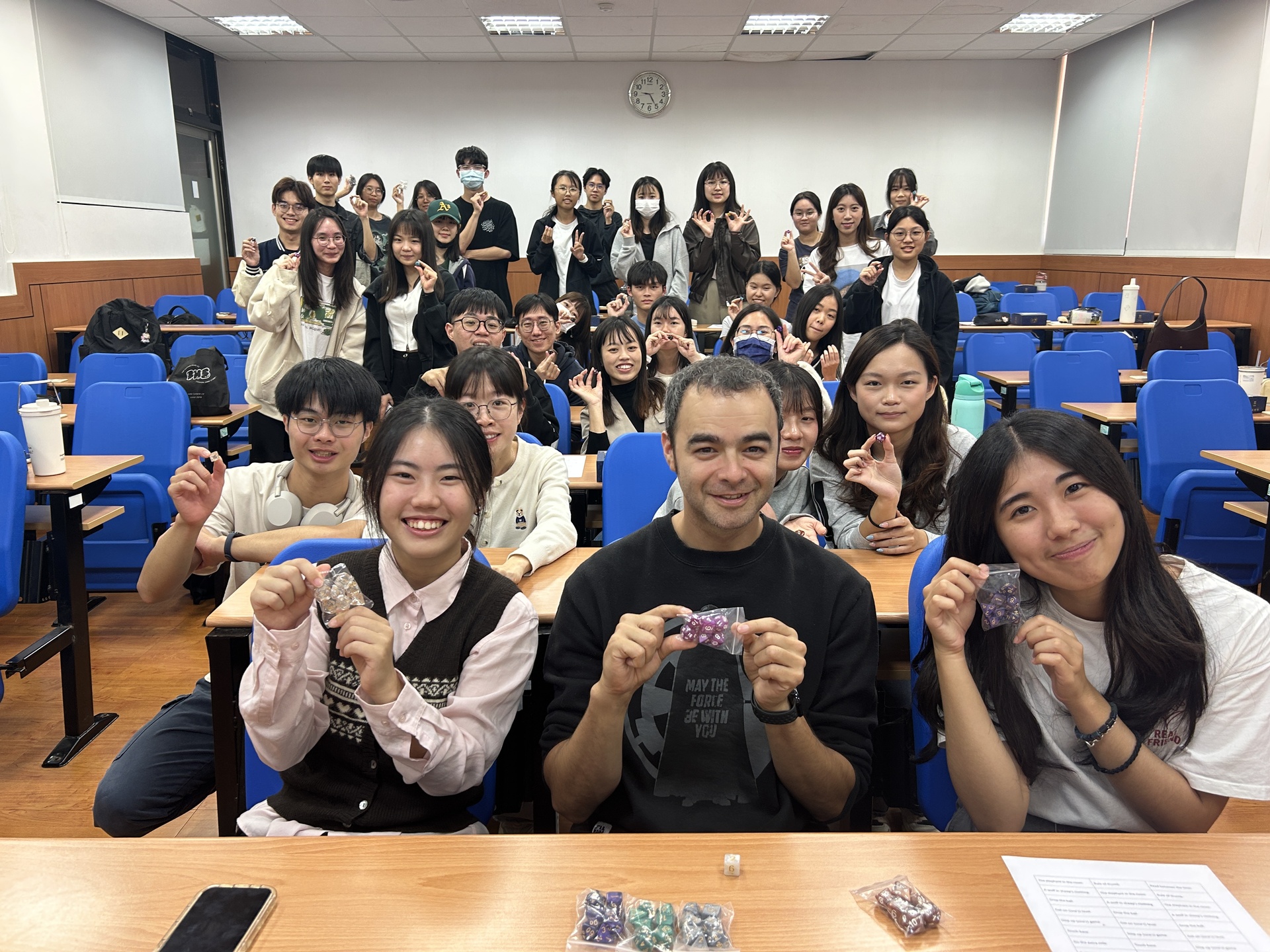


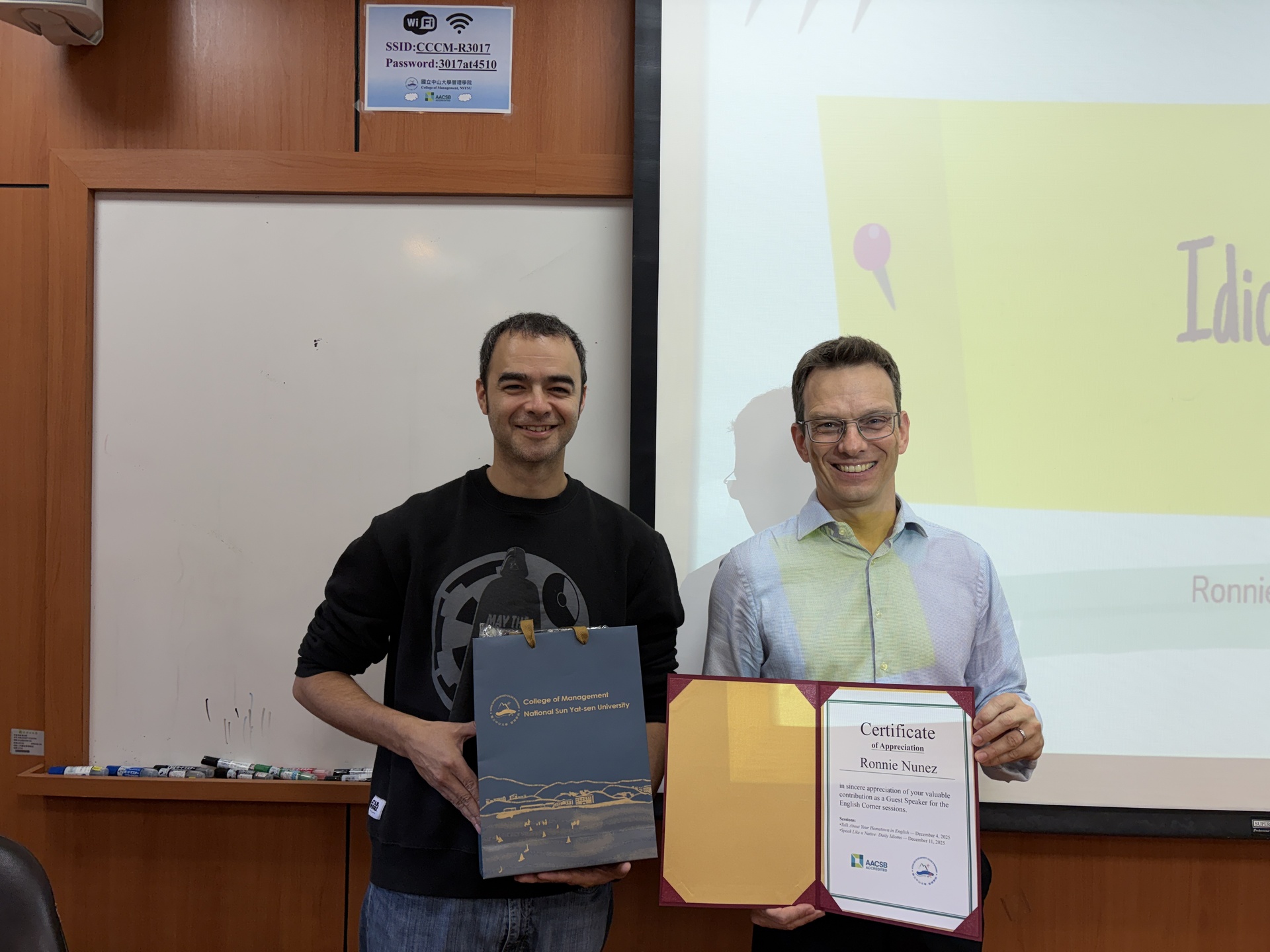
The International Relations and Accreditation Office hosted the sixth session of the English Corner series on December 11, 2025. The event invited Ronnie Nunez, who has over a decade of teaching experience, to engage with students. With a strong background in English education, cross-cultural communication, and curriculum design, Ronnie led the session through a relaxed and interactive approach. By using everyday examples, he guided students to understand the cultural context behind language forms and helped them break down common English idioms, enabling students to use them more naturally in daily conversations.
【Teaching English Idioms: From Understanding to Practical Use】
At the beginning of the session, Ronnie introduced the basic concept of idioms, emphasizing that their meanings often go beyond literal translation. To truly understand an idiom, learners must consider the context in which it is used and how it functions in real communication.
Through interactive questions, Ronnie introduced several commonly used idioms in daily life and workplace settings, explaining their meanings and practical usage, including:
- The elephant in the room: an obvious issue that everyone is aware of but avoids discussing
- Rule of thumb: a general principle based on experience rather than exact measurement
- Drop the ball: to make a mistake or fail to complete a task properly
With concrete examples, students were able to quickly grasp how these idioms are used in real-life conversations.
【“Get on One’s Level”: Using Language to Build Connection】
Ronnie also shared one of his most frequently used phrases, “Get on one’s level,” explaining that it refers to adjusting one’s communication style, pace, or attitude to better match another person. This approach helps make interactions smoother and more effective.
Using examples from basketball practice and family life, Ronnie illustrated how saying “get on their level” can highlight differences while also adding humor and encouragement. This makes others feel more motivated and engaged rather than discouraged.
He further provided example sentences to help students quickly understand its usage:
- “I try to get on my teammate’s level during practice.”
This emphasizes teamwork and mutual adjustment rather than comparison. - “Come on, get on my level!”
Commonly used among friends or in sports contexts with a light-hearted tone. Ronnie reminded students that this expression should be used carefully, as tone and familiarity are key to ensuring it sounds encouraging rather than provocative.
Through these relatable examples, even students encountering the phrase for the first time were able to understand its meaning and appropriate context.
【Hands-On Practice: Speaking Idioms with Confidence】
After introducing several idioms, Ronnie distributed worksheets to check students’ understanding and organized group activities. Each group was asked to create a short situational dialogue using three randomly assigned idioms.
Within a short time, students actively collaborated and brainstormed creative scenarios. One group, for example, used a game-based situation where a student said, “I dropped the ball in the game,” and another responded with, “Just get on my level,” to encourage their teammate. This lively exchange demonstrated how idioms naturally convey emotion and tone. The relaxed atmosphere greatly increased students’ willingness to speak, making language practice both engaging and rewarding.
【Extending Language Sense: Bringing English into Daily Life】
Toward the end of the session, Ronnie introduced commonly used spoken suffixes such as “-ish” and “-ly,” which convey meanings like “approximately” or “kind of.” For example, “coffeeish” can describe water that is roughly the temperature of coffee.
He also reminded students to avoid using overly informal expressions in formal writing or exams to maintain accuracy. This extension helped students better understand the flexibility of language and develop a more natural English “feel” in everyday use.
【Conclusion: Bringing Language to Life Through Cultural Understanding】
Through idiom analysis, situational dialogue practice, and language extension activities, the session guided students from cultural understanding to real-world application, comprehensively strengthening their English expression skills. With his humorous, engaging, and down-to-earth teaching style, Ronnie helped students build confidence in a supportive environment.
The workshop demonstrated that learning English is not just about memorizing vocabulary, but about knowing when and how to use language naturally in communication. By connecting language with daily life, English becomes not just a subject to study, but a truly effective tool for meaningful interaction.
📌 Please refer to the English Corner activity schedule for this semester:
(Written by Master of Business Administration Hsin-Ni Chang, Department of Financial Management Yu-Shan Huang / Edited by College of Management Media Team)